The game in one number
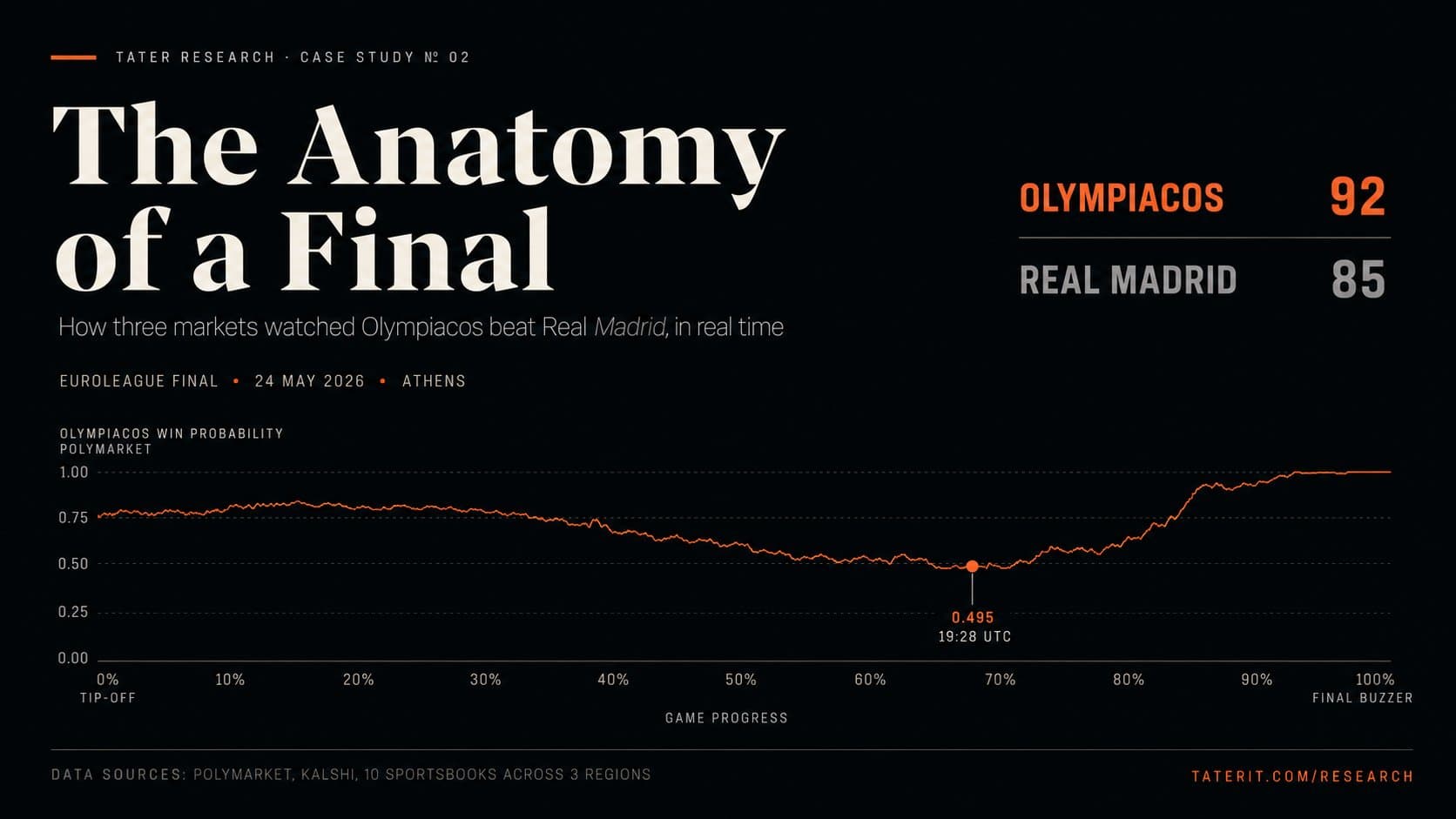
At 19:28 UTC on Sunday, 24 May 2026, the price of an Olympiacos victory on Polymarket fell to 49.5 cents on the dollar. It stayed there for one minute. Across town, on Kalshi, the same outcome traded at a mid-price of 49 cents. Across the Atlantic, the consensus across ten major sportsbooks implied Olympiacos at 51 percent.
For 60 seconds, the global market thought Real Madrid was going to win the EuroLeague Final.
Forty-three minutes later, the market thought Olympiacos was certain to win. The actual final was 92-85. In between those two moments lived the kind of intramarket story that almost no consumer ever gets to see: how three different platforms, with three different cost structures, three different liquidity profiles, and three different update cadences, all tracked the same 40 minutes of basketball in subtly, importantly different ways.
This is a reconstruction of that game from the market side. The data comes from 1,991 one-minute Polymarket price points, 577 one-minute Kalshi candlesticks, 2,462 individual Kalshi trades, and 95 sportsbook snapshots across ten books in three regions, all captured between 22 May and 24 May 2026.
It is also the second European championship Tater Research has reconstructed this month, after the Eurovision Song Contest grand final on 16 May. Both, as it turned out, ended with a Bulgarian protagonist. We will return to that thread before the close.
The market saw Olympiacos as the favourite throughout
Olympiacos win probability across three platforms
Drag the strip below the chart to zoom into any window across the ~30-hour spine, from market open on 22 May to the final buzzer on 24 May.
The 48 hours before tip-off
The most interesting thing about this game, from a market-structure perspective, did not happen during it. It happened in the two days leading up to it.
When the Real Madrid versus Olympiacos final markets opened on the evening of Friday, 22 May 2026, hours after the semifinals were decided, the world's sportsbooks did not agree on what kind of game this was going to be. They agreed on who was going to win, more or less. They did not agree on how the points would be scored.
Specifically, the totals line, the bet on the combined point total of both teams, opened in two distinct camps.
The books that took the line first, on Friday evening, posted it high. FanDuel opened at 171.5. Betsson opened at 171.5. Sport888 opened at 171.5. BetMGM opened at 170.5. The implicit theory of the game was high pace, both teams in form, championship intensity translating into transition basketball.
The books that took the line later, primarily on Saturday morning, posted it low. Pinnacle opened at 164.5. DraftKings opened at 164.5. Bovada opened at 165.0. Their implicit theory was the opposite: defensive intensity, Real Madrid's injury-depleted frontcourt limiting their pace ceiling, two coaches who would shorten possessions.
Over the next 36 hours, the high books walked down. The low books walked up. By tip-off, the market had converged on 165.5 to 166.0. FanDuel went from 171.5 to 165.5. BetMGM went from 170.5 to 164.5. Pinnacle went from 164.5 to 166.0. DraftKings went from 164.5 to 166.5.
This kind of pre-game convergence is exactly the prep-time intelligence that informs how a content creator frames a matchup. The story is not that "the line is 165.5." The story is that the line was 171.5 on Friday and 165.5 by Sunday afternoon, and the reason it walked down is the same reason this was always going to be a closer game than the moneyline suggested: Real Madrid was missing Walter Tavares, Usman Garuba, and Alex Len from their frontcourt, which constrained their pace. The 6-point drift was the market pricing that constraint.
For a sportscaster, this is the angle. Not "Olympiacos is favored." Everyone knows that. The angle is why the total moved six points and what that tells you about how the game will actually be played.
The spread told a similar but quieter story. The modal line settled at -7.5 Olympiacos. A few books opened wider: DraftKings and Bovada at -8.5 on Saturday morning. By tip-off, the late US money had tightened those positions. DraftKings closed pre-game at -6.5. Bovada at -7.0. Sport888 at -6.5. The signal was small but consistent: in the final hours, money came in expecting a tighter game.
The moneyline barely moved. The global consensus on Olympiacos held in a band between 72 and 76 percent across all ten books in all three regions through the entire pre-game window. The cross-region gap, the difference between the average US sportsbook implied probability and the average European sportsbook implied probability, stayed inside one percentage point for essentially every snapshot.
The market walked the total down six points before tip-off
Pre-game total line drift across 7 sportsbooks
The final two hours
In the immediate run-up to tip-off, the picture refined.
The pre-tip moneyline closed at:
| Source | Olympiacos implied probability |
|---|---|
| Polymarket | 0.755 |
| Kalshi (mid of yes bid/ask) | 0.735 |
| Sportsbook consensus (10 books, de-vigged median) | 0.728 |
That spread of 2.7 percentage points across three platforms and three market structures is the tightest you will ever see this kind of comparison get. Polymarket priced Olympiacos slightly more confidently than the sportsbooks, but the gap was small enough that no edge existed for an informed bettor moving between them.
The line-movement summary tells the rest of the pre-game story.
| Book | Region | Market | Open | Close pre-tip | Move |
|---|---|---|---|---|---|
| Pinnacle | EU | h2h | 0.737 | 0.722 | -1.44 pp |
| BetMGM | US | h2h | 0.710 | 0.728 | +1.80 pp |
| DraftKings | US | h2h | 0.742 | 0.714 | -2.72 pp |
| FanDuel | US | h2h | 0.736 | 0.736 | 0.00 pp |
| Bovada | US | h2h | 0.744 | 0.707 | -3.75 pp |
| William Hill | UK | h2h | 0.735 | 0.761 | +2.58 pp |
| BetMGM | US | totals | 170.5 | 164.5 | -6.0 |
| FanDuel | US | totals | 171.5 | 165.5 | -6.0 |
| Betsson | EU | totals | 171.5 | 165.5 | -6.0 |
| Sport888 | EU | totals | 171.5 | 165.5 | -6.0 |
| DraftKings | US | spread | -8.5 | -6.5 | +2.0 |
| Bovada | US | spread | -8.5 | -7.0 | +1.5 |
DraftKings and Bovada moved most on the moneyline, both toward Madrid. The same two books tightened the spread, also toward Madrid. Late US money was leaning, modestly but consistently, toward an Olympiacos win by less than the opening number said. Whether that money was right depended on the first 15 minutes of the game.
The game itself
Tip-off was 18:00:00 UTC. Real Madrid scored on the opening possession, then again, and again, and again. Trey Lyles, Madrid's American forward, scored 13 points in the first six minutes on his way to a 24-point night. By 18:10 UTC, ten minutes into the game, Real Madrid led 15-3. The Polymarket implied probability of an Olympiacos win had collapsed from 0.730 to 0.675. Kalshi from 0.735 to 0.665. The sportsbook consensus, still on its 5-minute snapshot grid, had only moved from 0.728 to 0.687.
By 18:13 UTC, with Madrid leading 26-19 to close out the first quarter, the divergence was sharper. Polymarket sat at 0.625. Kalshi at 0.605. Sportsbook consensus at 0.666.
This is the cleanest example you will find of prediction markets leading regulated sportsbooks on event-driven shocks. Over those 13 minutes, Polymarket moved 10.5 percentage points. Kalshi moved 13.0 percentage points. The sportsbook consensus moved 6.2 percentage points. The 1-minute-native markets captured roughly twice the magnitude of the price discovery that the 5-minute-native markets did. The Polymarket order book was reacting to every made basket, every defensive stop, every timeout in real time. The sportsbooks, by virtue of having to update lines through a different operational pipeline, were giving you a more lagged view of the same information.
Then the comeback. Olympiacos found its rhythm in the second quarter. Evan Fournier, who would be named Final Four MVP, sparked the run, joined by Tyson Ward and Alec Peters; the trio combined for 23 of Olympiacos's 25 second-quarter points per Real Madrid's official match report. Trey Lyles, who would finish the half with 21 points on five three-pointers, kept Real Madrid in striking range. But Olympiacos outscored Madrid 27-18 across the second quarter and went into the break leading 46-44. At 18:50 UTC, Polymarket priced Olympiacos at 0.795. Kalshi mid at 0.790. Sportsbook consensus at 0.7652.
The three platforms had agreed on something striking. The pre-tip price was 0.728 to 0.755 across them. The halftime price was 0.765 to 0.795. After 20 minutes of basketball that had included a 12-point Madrid lead and a 14-point Olympiacos counter-run, the market thought the game was a small notch more in Olympiacos' favor than it had thought when the game started. Twenty minutes of intense back-and-forth had produced approximately a 4-percentage-point net update.
The third quarter was Madrid's. Mario Hezonja inspired a 21-15 quarter that put Real Madrid back in front, opening up roughly a six-point lead in the closing minutes of the third. At 19:28 UTC, with Madrid up by their largest second-half margin, Polymarket touched 0.495. Kalshi touched 0.490. The sportsbook consensus held at 0.597, a full 10 percentage points higher.
That 0.495 stood as the implied probability for exactly one minute. By 19:29 UTC, Polymarket had recovered to 0.560. By 19:30 UTC, both Polymarket and Kalshi were back above 0.530. The fast markets had registered the precise moment of maximum Madrid pressure, and the moment passed.
The fourth quarter was Olympiacos. The home team outscored Real Madrid 31-20 in the final 10 minutes. Cory Joseph drilled a three-pointer to put Olympiacos ahead 67-65 early in the period, and from there Olympiacos extended the lead before Alec Peters sealed the game from the free-throw line in the closing seconds. Evan Fournier led Olympiacos with 20 points, 5 rebounds, and 4 assists. Peters added 16 points and 7 rebounds. Sasha Vezenkov scored 12; Thomas Walkup 10. Trey Lyles led all scorers with 24 points for Real Madrid, with 21 of those coming in the first half. Mario Hezonja added 19. Polymarket walked from 0.495 to 0.700 over the first 12 minutes of Q4. From 0.700 to 0.900 in the next eight. From 0.900 to 0.995 in the final four minutes. The whole comeback, from minimum probability to certainty, took 43 minutes of market time and produced a 50.5-percentage-point swing.
The game itself: Polymarket led every inflection point
Olympiacos win probability in-play
Drag the strip below the chart to zoom — e.g. into 19:25–19:35 UTC, where Polymarket and Kalshi touch the 0.495 low at the peak of Madrid’s third-quarter surge (the “Q3” band).
Microstructure sidebars
Three things showed up in the data that are worth flagging for anyone trying to build a market-structure intuition from this game.
The end-of-game suspension artifact. In the final 5-minute snapshot of the in-play window, at 20:10 UTC, the US sportsbook consensus implied Olympiacos at 0.90 while the European consensus implied 0.66. A 24-percentage-point gap. This is not the US books and the European books disagreeing about the outcome of a game that was effectively over. It is the books closing their markets at staggered times. As individual operators suspend trading near the final buzzer, the consensus pulls toward whichever books remain open. The "EU is much less confident than the US" reading is an artifact of which books were still posting prices, not of what those books believed. The right read on cross-region disagreement in the final two to three minutes is that there is none.
US and EU sportsbooks tracked each other until the final buzzer
Cross-region sportsbook consensus and the closing gap
Why Polymarket and Kalshi do not list spreads or totals on EuroLeague. Through this entire piece, the spread and total stories have come exclusively from sportsbook data. Polymarket and Kalshi listed only moneyline markets on this EuroLeague Final, and our wider audit of EuroLeague-related markets on both platforms found the same pattern. This contrasts sharply with their NBA coverage, where moneyline, spread, total, and player prop contracts all trade actively on any given night. The gap is not platform policy on basketball as a sport, it is platform policy on European basketball specifically. Whether the EuroLeague gap is a function of demand, regulatory positioning, or just a coverage seam that closes as prediction markets expand globally is one of the more interesting questions for 2026 and beyond. Until it does close, two thirds of the standard sports betting market structure for EuroLeague exists only on sportsbooks.
The Polymarket 10-minute trap. A technical note for anyone building their own market analysis on Polymarket data: their CLOB prices-history endpoint silently downsamples to 10-minute granularity when you query the full lifetime of a market with interval=max, regardless of what fidelity parameter you pass. The only reliable way to get true one-minute resolution after the first 24 hours is to use explicit start and end timestamps with fidelity=1. We discovered this during the data audit for this piece. The published prediction-market analytics ecosystem is small enough that this kind of methodological detail is genuinely worth flagging.
A Bulgarian thread
This is the second European championship Tater Research has reconstructed this month. Eight days before Olympiacos took the EuroLeague title in Athens, the Bulgarian singer Dara took the Eurovision crown in Vienna. Both contests were settled by late comebacks. Both starred a Bulgarian protagonist.
The protagonist on the Athens floor was Aleksandar "Sasha" Vezenkov. The 30-year-old Olympiacos power forward was named the 2025-26 EuroLeague regular-season MVP in April, his second time taking the league's top individual honour and only the second player in history to win it twice, joining Anthony Parker. He led the EuroLeague in scoring at 19.4 points per game and topped the Performance Index Rating at 23.1. He was named Bulgarian Athlete of the Year in both 2022 and 2023.
In the Final itself, Vezenkov's stat line was the quietest of his Final Four: 12 points. The work he had done to get Olympiacos to this game was already done. He had led the team through a regular season for the ages and closed out Fenerbahce in the semifinal two days earlier. In the Final, he played his part and let his teammates close. When the buzzer sounded, footage of Vezenkov turning to the OAKA crowd and leading the chants was what Olympiacos's social channels led with. The season MVP got to lead the party.
Hours before tip-off, Dara, the Bulgarian singer who had won Eurovision in Vienna eight days earlier, posted an Instagram story tagging Vezenkov: "Also wishing all the luck to @sashavezenkov today!!!" A Bulgarian Eurovision champion publicly cheered on a Bulgarian EuroLeague star. Both subsequently lifted their cups. Whether that counts as the most charming weekend in modern Bulgarian sport and culture is a matter for someone else to argue. For us it counts as the second European championship in a row where the market story and the human story were both worth telling.
What this means
This was one game. Forty minutes of basketball. Three market platforms with very different liquidity profiles, cost structures, and update cadences. The signal from the data is consistent.
Prediction markets lead regulated sportsbooks on event-driven shocks. The Polymarket and Kalshi prices reacted faster and harder than the sportsbook consensus during both Madrid's early run and the Q3 surge. The 1-minute native resolution mattered. If you wanted to know what the market thought of the game in real time, the prediction markets were the place to look.
Markets process, they do not predict. In our Eurovision case study earlier this month, the prediction-market price for Bulgaria moved with each jury and televote reveal but no platform priced Bulgaria as the eventual winner before the public reveals made it inevitable. On 24 May in Athens the same logic held at game speed: prices moved with each made basket and each lead change, but no platform priced Olympiacos's comeback before it began, and the 0.495 low at 19:28 UTC was synchronous with Madrid's largest second-half margin, not predictive of its end. The "Polymarket leads sportsbooks" finding belongs inside this frame. It is about who is fastest at processing what is already public, not who is best at forecasting what is still unknown. Markets are not oracles. They are the fastest aggregator of consensus on already-public information. On this game, that aggregator was Polymarket.
Sportsbooks anchor the line structure on European basketball. For this EuroLeague Final, the spread and total markets existed only on sportsbooks. The 6-point pre-game total drift, the 2-point pre-game spread tightening, the 10-book consensus on Olympiacos at 72.8 percent, all of this came from the sportsbook side. A market view that does not include sportsbook data has no opinion on how the points will be scored in this league. Prediction markets fill that gap on NBA today. They have not yet filled it on EuroLeague.
The pre-game window is where most market intelligence lives. The 48 hours before tip-off contained a clean, story-worthy line movement: the total walked down six points, books in two continents converged on the same number, US money tightened the spread in the final hours. By the time the game tipped off, the most valuable market intelligence was already in the data. The in-play movements were dramatic, but they confirmed what the pre-game movements had already signaled: this was going to be a closer, lower-scoring game than the opening lines suggested.
For sports content creators preparing coverage of a championship game, the pre-game window is where research time should be spent. By the time the ball is in the air, the market has already done most of its thinking.
The 2026 FIFA World Cup begins on 11 June. Every match between then and 19 July will move through the same pre-game, immediate pre-game, and in-play windows that this EuroLeague Final did. Tater will be capturing the data continuously. The format of analysis you have just read is the format we expect to run, in different shapes, on every match of the tournament.
If you build content, run a sportsbook, work in a prediction market platform, or invest in any of the above, we would be glad to talk about what this kind of cross-platform visibility means for your work. The case for it is right here in the data.
The full data underlying this analysis, including the per-book line movement summary, the cross-region gap timeline, and the de-vigged moneyline spine across all three platforms, is available as CSV downloads at the bottom of this page.
Methodology note. All implied probabilities have been adjusted to remove sportsbook vig using the symmetric two-way normalization. Cross-platform comparisons use the de-vigged median across the ten tracked books for the sportsbook consensus, the last-traded price for Polymarket, and the midpoint of yes-bid and yes-ask for Kalshi. Sportsbook snapshots are spaced at 5-minute intervals; Polymarket and Kalshi data are 1-minute native. Source data was captured between 22 May and 24 May 2026 across Polymarket Gamma API, Kalshi Trade API v2, and The Odds API historical endpoint. Tracked books: Pinnacle, Betfair Exchange (EU), BetMGM, DraftKings, FanDuel, William Hill, Betsson, Marathonbet, Sport888, Bovada. The game was played at the Telekom Center Athens (OAKA). Score and player statistics are sourced from EuroLeague Basketball's official game center and the Real Madrid match report.
About Tater. Tater is the discovery and comparison layer for prediction markets and sportsbooks. We aggregate real-time prices across 16 platforms, surface cross-platform edges, and help users find the best lines without holding accounts everywhere. Learn more at taterit.com.